All year
Sperm whale
The resident
- SeasonAll year
- Field markBushy, angled blow
- GroupLone males
Guides
Language
Currency
Check open spotsfrom $103 · no fee to cancelChecklist to tick off
Things to do · 10 items
Tick each item when it is done. Your place is saved on this device.
0 / 10 ready
Nothing left to do. All that is left is to pick your sailing time.
Save a placeThe Kaikoura whale watching species list runs from resident sperm whales to passing blue whales, with dolphins, seals and albatross in between. Here is who you might meet, when, and how to tell them apart.
Editorial team, kaikourawhalewatching.quest · Updated November 8, 2026 · Read in 8 min
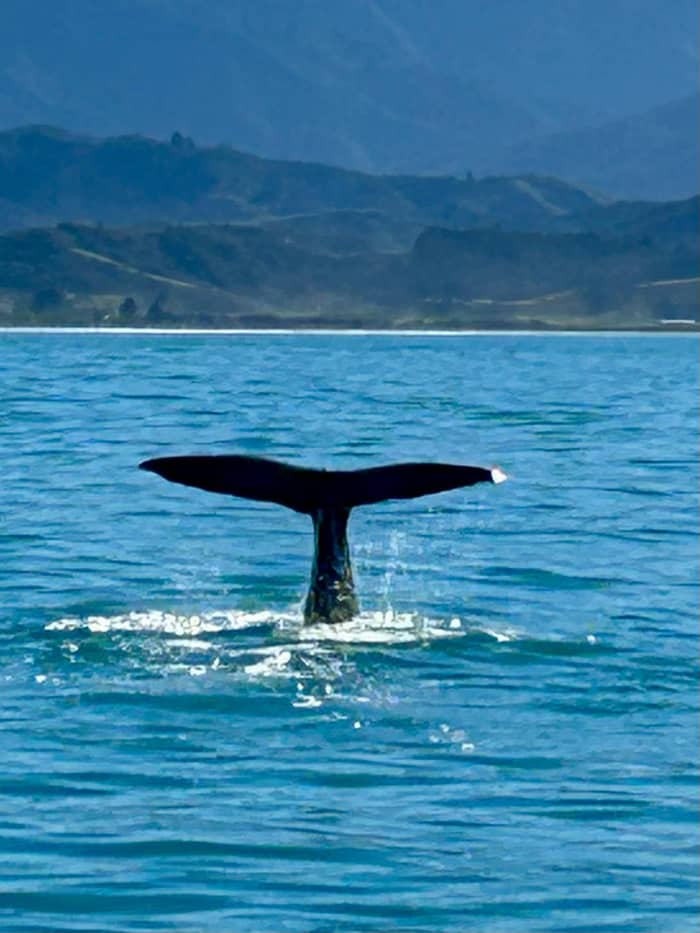
Any list of Kaikoura whale watching species starts with the sperm whale, the one animal the boats can count on. DOC says the species is found off Kaikoura in every season, drawn by the deep submarine canyon close to shore.1 The local whales are mostly males, a mix of residents and passers-by.6 Expect 1-2 of them on a typical trip, the operator says; they spread out over a wide area and spend long spells deep under water.7
You will know one when you see it. DOC describes a large, square head making up around one third of the body, wrinkly skin and a low hump instead of a tall dorsal fin.8,9 Its single blowhole sits on the top left of the snout, and the angled, bushy blow makes the whale easy to spot even when little else shows.9,10 When it dives, the broad flukes lift clear of the water. Our page on sperm whales and the canyon covers the dive cycle and the hydrophones in depth.
Every other species below depends on season and luck. Destination Kaikoura says up to 14 other species of whales and dolphins share these waters with the sperm whales at different times of the year.11 The operator goes further, claiming that around 80% of all whale and dolphin species on Earth travel past this coast.12 Read both figures as a measure of possibility, not a promise: on most trips you will meet a handful of species, not a parade.
Field guide
| Species | When | Look for |
|---|---|---|
| Sperm whale | All year | Angled, bushy blow |
| Humpback | Jun · Jul · Aug | Long white flippers |
| Orca | Summer | Tall black fin |
| Blue whale | Passing | Huge, mottled grey back |
| Southern right | Rare, winter | No fin, V-shaped blow |
| Dusky dolphin | All year | Somersaults |
| Hector's dolphin | Close inshore | Round black fin |
| Fur seal | All year | Dark shapes on rocks |
Seasons and field marks as DOC and the boat operator describe them.1,10,2,3,24,28,29,30,31,32,33,34
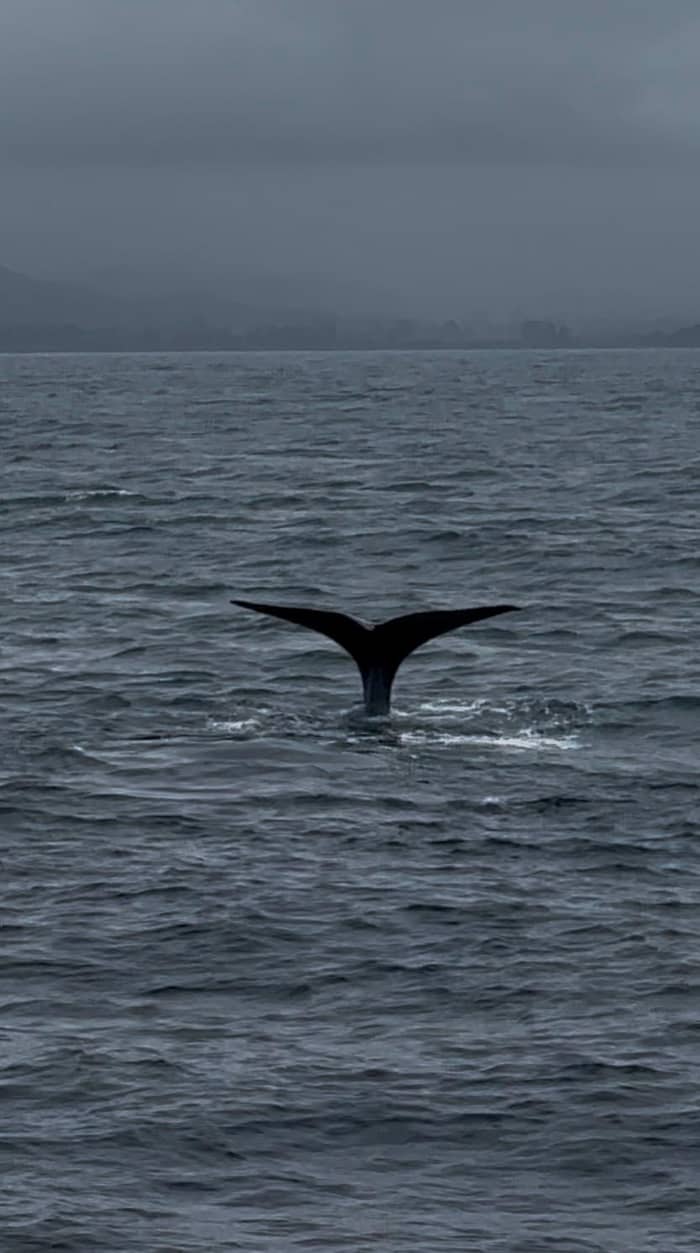
If you want to see a humpback whale in Kaikoura, come in winter. The operator logs humpbacks most often in the winter months of June, July and August, and some put on a show of breaching, spyhopping, lobtailing and flipper slapping.2 According to DOC, their winter journey north follows the South Island's eastern shore, and in spring they head back south along the west coast.13 They are on a long journey, roughly 10,000 km a year between Antarctic feeding grounds and tropical breeding waters.14
Humpbacks are easy to tell from sperm whales. They have long flippers and a small dorsal fin with a hump in front, and DOC notes that the black and white pattern under each tail fluke is unique enough to identify individual whales.15 The operator says they usually take a breath every 20-30 seconds over two or three minutes and then stay down for 3 to 28 minutes.16 That shorter rhythm means a humpback often stays in view longer than a sperm whale.
Their story is one of recovery. New Zealand's own whaling ended in 1964, DOC records, with the last station shutting down in Tory Channel.17 The Oceania population was still classed as endangered by the IUCN in 2008.18 Humpbacks also come very close to shore here, which puts them at risk of tangling in craypot lines.19 DOC has counted them in Cook Strait every year since 2004 to track their return, and photos of tail flukes from the public help that work.20
Size check
Adult Hector's about 1.5 m, dusky male maximum 2.11 m, fur seal male maximum 2.5 m and orca up to 9 m per DOC; southern right up to 17m and fin whale up to 24 meters per the operator; blue whale female average 26.5 m per DOC.21,22,23,24,25,26,27
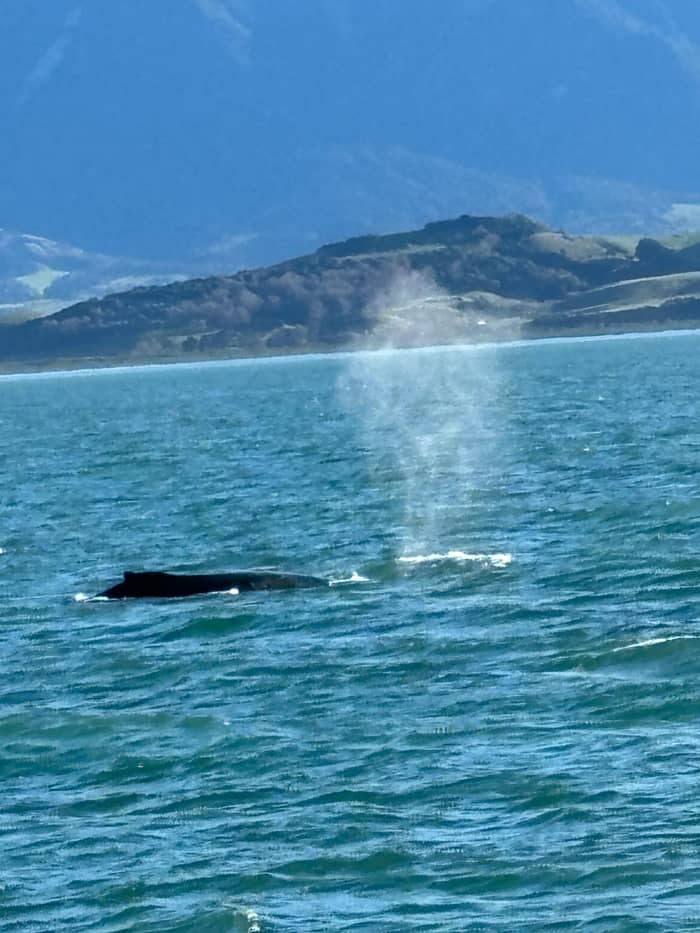
Orca watching in Kaikoura is a summer game. The operator says killer whales often visit, especially during the summer months.3 DOC points out that, whatever its name suggests, the killer whale is in fact the biggest dolphin of all.36 Orca can grow up to 9 m long, and an adult male's dorsal fin can stand higher than a metre, which makes a group of them unmistakable even far off.24 Females have smaller, more curved fins.
New Zealand has only a small population. DOC estimates 150-200 orca in the country's waters, travelling long distances along the coast.37 They are the only known cetaceans that regularly hunt other marine mammals, and their diet runs from fish and rays to seals.38 Sightings never follow a timetable. A summer trip raises your chances, but nobody can promise an encounter, and the crew will only tell you on the day whether orca have been seen along the coast. Keep watching for that tall black fin.
Strict rules apply when orca are near. The Marine Mammals Protection Regulations 1992 make swimming within 100 m of a whale an offence, and orca count as whales under those rules.39,40 Aircraft should keep at least 150 m from orca and avoid flying directly overhead.41 From the shore, watch quietly and report sightings to DOC: they feed the national sightings database that helps scientists follow these animals.
Match your hopes
Pick the creature you most want, then the time and the way to see it.
If I want a whale, any whale
Sperm whale, any month
Resident off this coast through the year.1
If I want a breaching humpback
Come June to August
The operator sees humpbacks frequently in those winter months.2
If I dream of orca
Come in summer
Summer is when orca visit this coast most often.3
If I love dolphins
Any month, watch the midday rest
Duskies are here all year; Nov to Mar viewing pauses 11.30am to 1.30pm.30,35
If I am a birder
Bring binoculars on the boat
13 species of albatross visit the waters off Kaikoura.5
Three to hope for
All year
The resident
June to August
The winter traveller
Summer
The summer hunter
The giants appear without warning. DOC calls the blue whale the largest animal in the world and notes that the Southern Hemisphere holds both Antarctic and pygmy blue whales.47 Mature males there average 25 m in length and females 26.5 m.27 The operator sees blue whales off Kaikoura at various times of year, usually passing through, and treats each sighting as something special.28 Fin and sei whales are seasonal visitors too.48
Fin whales reach up to 24 meters, second only to the blue whale in size, according to the operator.26 Southern right whales, tohorā in Māori, look very different: no dorsal fin, white callosities on the head and a V-shaped blow. DOC gives adults an average of 14-15 m.42 Most of them spend the winter and spring breeding season far to the south, around the Auckland and Campbell Islands, and the mainland sees only the odd visitor.29
Two other groups round out the list. Long-finned pilot whales travel in family pods of 20-100, and although they belong to the dolphin family, the regulations treat them as whales.49 Beaked whales are the true rarities: the operator says the chance of seeing any of the 11 species known in New Zealand waters is slight.50 If one of these surfaces on your trip, the crew will be as excited as you are.
Ways to see them
Each way shows different animals; set your group size to compare.
Compare 3 alternatives
Each way shows different animals; set your group size to compare.
≈
View≈
View≈
ViewConverted at the ECB reference rate, from-prices as listed by GetYourGuide. The precise amount is shown when you book.
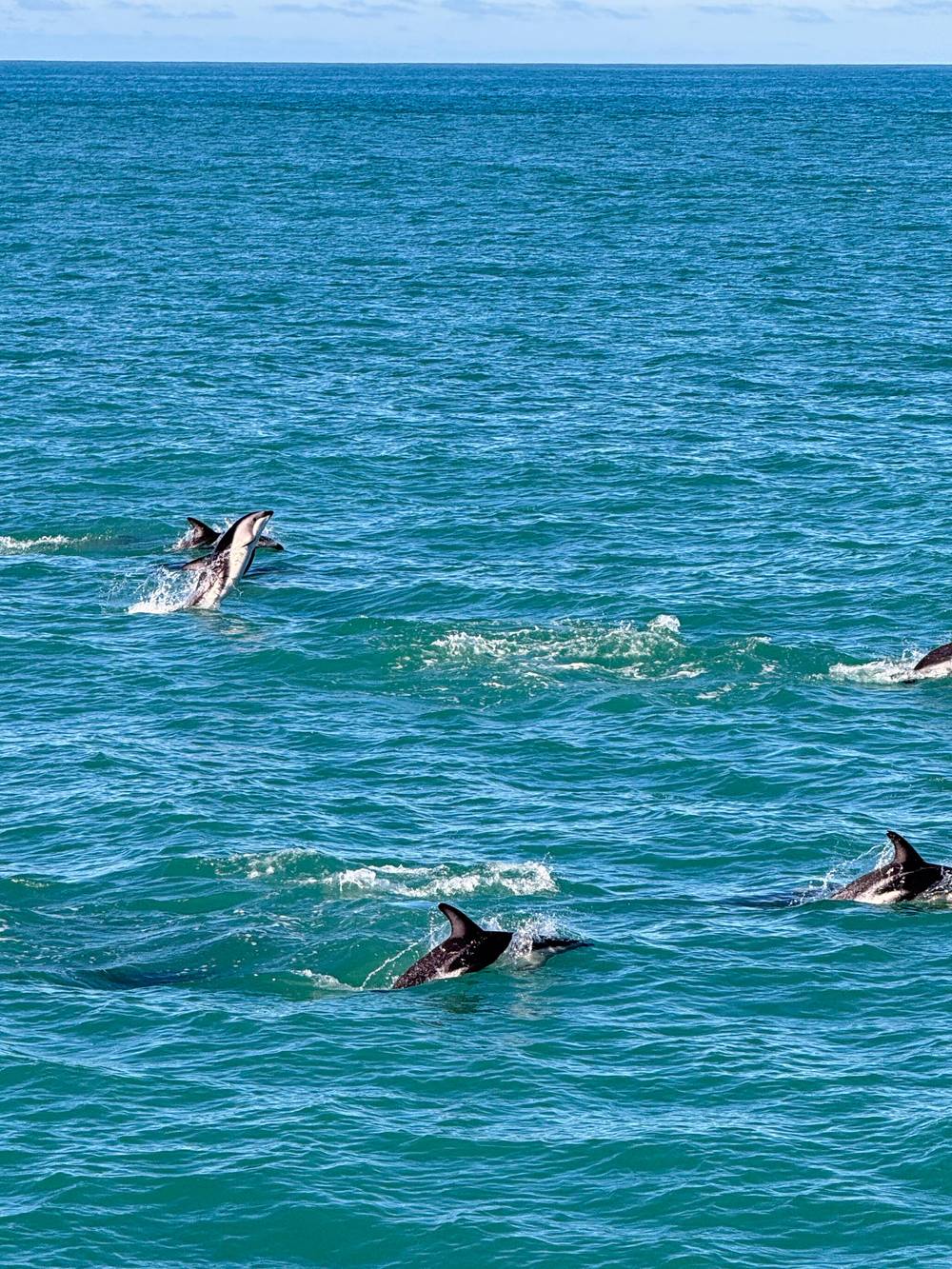
Dusky dolphins are the acrobats of this coast. The operator says pods around Kaikoura number anywhere from 100 to 800 animals.4 DOC records large groups, sometimes of over 1000, present all year round.30 Their trademark leap is a somersault, repeated again and again.31 Adults are small and dark-backed, with a female reaching at most 1.93 m and a male 2.11 m.22 From November to March a DOC rest period stops dusky viewing between 11.30am and 1.30pm.35
Hector's dolphins are the rarity. The operator explains that they live only in New Zealand and are often seen close to shore at Kaikoura in small family pods of 4 to 8.32 Adults are about 1.5 m long, and unlike other dolphins they have a very rounded dorsal fin.21,33 That round fin, like a small black ear, is the field mark to look for. If you see one from land, DOC welcomes sighting reports, which help researchers follow the species.
Other dolphins drop in from time to time. Common dolphins can gather in enormous schools, and the operator has often seen them travelling with duskies off Kaikoura.51 Bottlenose dolphins only make occasional appearances here.52 Southern right whale dolphins, the only dolphins in the southern hemisphere without a dorsal fin, pass along the coast in pods of 100 to 200.53 Watch for their sleek black backs bounding low over the water.
Video
TravelwildTV on YouTube · Tap play to load the video; not before.
Despite its confusing name, the killer whale is actually the largest member of the dolphin family
New Zealand fur seals, kekeno, are the easiest animals here to meet on foot. DOC calls them the most common seals in New Zealand and says their numbers are growing.34 Adult males reach up to 2.5 m and 90-150 kg, far bigger than the females.23 They feed almost entirely at night, and many spend the day lying still on the rocks.54 The operator notes that seals ashore are resting, not sunbathing, and slip into the sea to cool down.43
Breeding runs from mid-November to mid-January, when pups are born and females mate again.55 DOC reported a new strain of canine distemper virus in the Kaikoura seal population in 2024, a reminder that these colonies need room.56 Local iwi regard kekeno as a taonga, a treasured species, DOC notes.57 Its advice is simple: keep 20 m back and never reach out to touch one, however relaxed it looks on the rocks.58,59
Now and then a rarer seal hauls out. The operator says leopard seals occasionally visit Kaikoura and come ashore to rest on their journey.60 Elephant seals have been seen as well.60 Treat any big seal on a beach with extra caution, keep dogs well away and report animals that look injured or harassed to DOC's hotline. Our page on watching whales from the shore covers the seal colonies at Point Kean and Ohau Point and the rules for visiting them.
Kaikoura is as good for seabirds as for whales. The operator counts 13 species of albatross and 14 varieties of petrels in these waters.5 It also says the area is home to around 75% of the world's pelagic seabird species.61 The wandering albatross is the one to look for: at almost 4 metres, its wingspan is the greatest of any living bird.44 Gibson's albatross, which breeds in the Auckland Islands, is the main species seen here.62
Hutton's shearwater is Kaikoura's own seabird. DOC says it is the only seabird in the world to breed in sub-alpine country, nesting high in the Seaward Kaikoura Range.63 On their downhill flight to the sea they reach up to 154 km/h and can reach the ocean in as little as seven minutes.64 In summer, DOC notes, large rafts of them sit on the water off the peninsula.45 Their breeding season runs from August to March.65
Penguins are small and easy to miss. The little blue penguin, about 25cm tall, is the world's smallest, and a small colony lives near the Coastguard building at South Bay.66 DOC adds that blue penguins may be seen bobbing just offshore from the Point Kean tidal platforms.46 Bring binoculars on the boat and on the walkway: many of the birds that follow whale boats, such as petrels, hang around feeding animals for scraps.
FAQ
It is the one whale resident here in every season, according to DOC.1
The operator sees them frequently in those winter months, June to August.2
The operator says orca often visit, especially in the summer months.3
The operator sights them now and then through the year, mostly travelling past.28
The operator counts 13 species of albatross in the waters off Kaikoura.5
Sources
More to read
Wondering if the whales will show? A real person answers here.